


Weighing the options: Which conveyor system is the best fit for your Car Wash?
The capacity of a car wash is largely determined by its conveyor system. Teh choice betewee a chain conveyor and a plastic modular conveyor belt afffects not only vehicle throughput, but als reliability, maintenance requirements, and the customer experience.
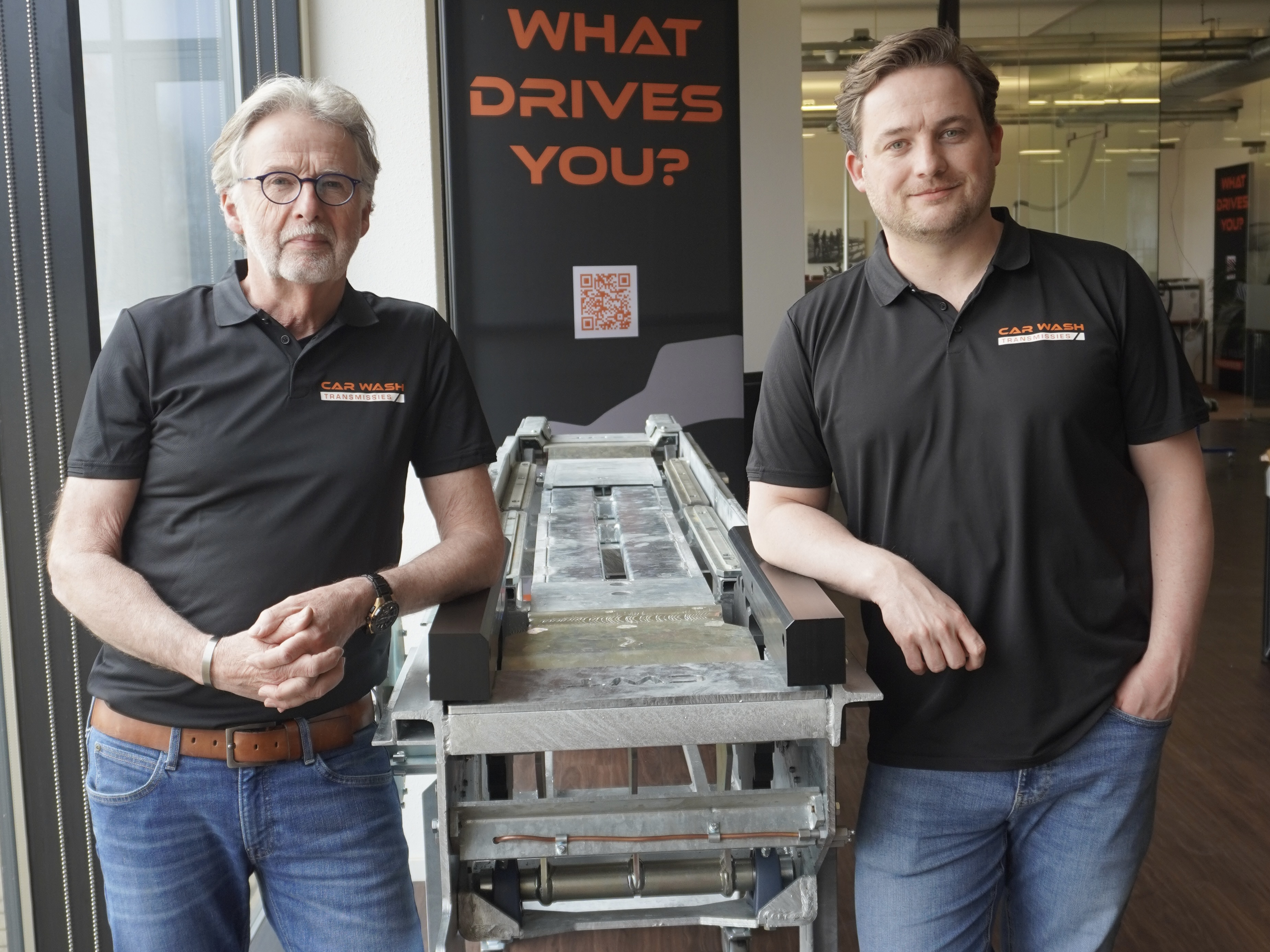 In the car wash industry, the choice of conveyor system plays an important role in operational efficiency. The traditional chain conveyor has been a trusted solution for many years, while plastic modular conveyor belts have gained popularity in recent years. Although both systems serve the same purpose – moving vehicles through the car wash in a controlled manner – they differ significantly in terms of cost, customer experience, and maintenance requirements.
“It is difficult to estimate how many chain conveyors are currently in use in the Netherlands compared to plastic modular conveyor belts,” says Patrick Ketelaar, who founded Car Wash Transmissies together with his father, Hans. The company provides transmission solutions for both interior and exterior conveyor systems in car washes.
“However, we are seeing a shift in the market. Particularly at new car wash locations, we notice that almost every operator opts for a plastic modular conveyor belt. At the same time, existing car wash locations with traditional chain conveyors tend to stick with their current systems due to the investment costs and the downtime required to switch from a chain conveyor to a plastic modular belt.”
Investment
Chain conveyors have been used in the car wash industry for decades. The system operates using rollers positioned at fixed intervals along a chain, which push vehicles forward through the car wash. One of the main advantages of a chain conveyor is its cost. “Compared to a plastic modular conveyor belt, the investment is significantly lower,” explains Hans Ketelaar. “The price largely depends on the length of the car wash, but as a general rule, a chain conveyor is approximately two to two and a half times less expensive.”
The length of the car wash also plays a role in choosing the right conveyor system. Patrick Ketelaar explains: “A chain conveyor is relatively easy to install over longer distances and can be extended to approximately sixty metres without any major issues. With plastic modular conveyor belts, the situation is different. Due to their construction, in which a large section of the belt is suspended, ensuring sufficient stability becomes technically more challenging beyond approximately fifty metres. Furthermore, as the length of the system increases, the forces acting on it increase exponentially. The system must be capable of handling these forces.”
Another functional advantage of chain conveyors that is often mentioned within the industry is that all four wheels rotate during the washing process. This is said to make wheel cleaning easier. It is an argument that Jean-Pierre Claassen, Segment Industry Manager Automotive at Ammeraal Beltech, a supplier of modular conveyor belts, frequently hears. “However, I don't entirely agree with that,” he says. “With the right chemicals and sufficient dwell time, wheels can be cleaned effectively. At the same time, vehicle wheels are increasingly designed with aerodynamics in mind, which also makes them easier to clean on a conveyor belt. Furthermore, with the growing number of electric vehicles, which produce less brake dust because they rely more on regenerative braking rather than conventional disc brakes, wheels are becoming less dirty in the first place.”
Larger vehicles
Both Jean-Pierre Claassen and Patrick Ketelaar also point out that traditional chain conveyors are generally less suited to the current generation of vehicles. “Cars have become larger and longer in recent years, while the spacing between the rollers on a chain conveyor has remained unchanged,” explains Claassen. “These rollers are positioned at fixed intervals and cannot currently be adjusted. As a result, they do not always align well with the wheelbases of modern vehicles, which can lead to less efficient transportation. Moreover, if a vehicle misses a roller, it cannot simply move forward immediately afterwards but must wait for the next roller to arrive. This quickly creates a gap of three and a half metres with no vehicle occupying that space. Quite simply, this means fewer cars can be washed per hour.”
A plastic modular conveyor belt uses a dual-track transport system, with the wheels on both the driver's side and the passenger's side resting on separate plastic belts that move simultaneously. This dual-lane configuration allows vehicles to enter the car wash in a straight and stable position. Vehicles can also be positioned closer together, as there are no rollers to take into account. As a result, the distance between vehicles can be reduced to approximately one and a half metres. “Cars can be positioned closer together on a conveyor belt. This offers a clear advantage, particularly during peak hours,” says Hans Ketelaar.
How many cars per hour can a chain conveyor handle compared to a modular conveyor belt? How fast does a conveyor belt move?
Ease of use
Another advantage is that the vehicle remains stationary relative to the moving belt, meaning its wheels do not need to rotate. Jean-Pierre Claassen explains: “We often see drivers accidentally applying the brakes on a chain conveyor, or electric vehicle drivers unfastening their seat belts, which can cause the vehicle to shift directly into park. Drivers do not always know how to resolve the situation, which can lead to panic. This creates a negative car wash experience and increases the likelihood that they will not return. In that respect, a conveyor belt is more customer-friendly. ”With chain conveyors, staff assistance is almost always necessary, whereas a modular conveyor belt can, in principle, operate without supervision. “In countries such as Canada, there are car washes that have been operating 24/7 for years without on-site staff assisting vehicles onto the conveyor belt,” says Jean-Pierre Claassen. “In the Netherlands, it is mainly a matter of getting used to the concept.”
Maintenance
The two systems also differ in terms of maintenance requirements. While Jean-Pierre Claassen describes chain conveyor maintenance as “fairly intensive”, Patrick Ketelaar believes it is difficult to make a direct comparison. Both systems require different types of maintenance, with cleaning being the main focus for modular conveyor belts. In the case of Car Wash Transmissies' system, this issue has largely been addressed through the installation of a flushing system. “A chain conveyor is rarely thoroughly cleaned. This is because the chain is a relatively open installation. During the vehicle washing process, the installation is essentially…”
Does a chain conveyor need lubrication? If so, approximately how often? Both Jean-Pierre Claassen and Patrick Ketelaar point out that a chain conveyor generally needs to have its sides swapped after approximately 100,000 to 150,000 washes. This means moving the left-hand side to the right and vice versa. In addition, the chain can stretch over time, requiring adjustment. At Loogman Carwash in Capelle aan den IJssel, the maintenance team carries out this work themselves, a process that takes an entire day. “The advantage at Loogman is that they have two car wash tunnels,” says Jean-Pierre Claassen. “It is a substantial job, but the impact on revenue is limited because vehicles can continue to be washed in the other tunnel.”
A modular conveyor belt requires a different type of maintenance. Although there is less conventional mechanical wear, cleaning plays a more significant role. “Sand and other debris affect the lifespan of the components,” explains Patrick Ketelaar. “A conveyor belt is a much more enclosed system, which makes it harder to clean. That is why we have equipped our installations with a flushing system. The belt is continuously rinsed, preventing sand from accumulating between the components and reducing wear.”
Jean-Pierre Claassen adds that lubrication is unnecessary and maintenance can be carried out without specialised tools. “What modular conveyor belts do – after all, they are made of plastic – is stretch slightly, particularly during the initial operating period. After a few months, you therefore need to check whether the belt has stretched too much and shorten it if necessary. But that is a quick job: you stop the conveyor, take a screwdriver and a hammer, and within two minutes you are finished. Apart from that, hardly any maintenance is required.”
Service life
Both parties find it difficult to specify exactly how long a plastic modular conveyor belt or a chain conveyor will last. For chain conveyors, a service life of approximately 500,000 washes is often mentioned as a guideline, although this depends heavily on maintenance and environmental conditions. In certain regions, for example, sand can accelerate wear. Ammeraal Beltech recently achieved a result of 1.5 million washes in the United States. “For now, that is an exception rather than the rule, but it certainly demonstrates the potential,” says Jean-Pierre Claassen.
In terms of sustainability, Hans Ketelaar considers the chain conveyor to be the better option. “In terms of materials, there is not much difference between the two systems. Both structures consist largely of steel, which can be melted down and recycled. With plastic modular conveyor belts, however, recycling is currently more challenging. I would say energy consumption is a more significant factor. This is an area of concern with modular conveyor belts, as these systems require larger motors and their flushing systems also consume electricity continuously. We see that this prevents some car wash operators from investing in these systems because their locations do not yet have sufficient electrical capacity.”
Ultimately, the choice between a chain conveyor and a plastic modular conveyor belt appears to depend primarily on the specific circumstances of each car wash. The chain conveyor remains a reliable and affordable solution, while the modular conveyor belt stands out particularly in terms of throughput capacity.
“It ultimately comes down to making the right choice for your location,” Hans Ketelaar concludes. “There is no right or wrong answer. Above all, the system needs to fit your business model.”